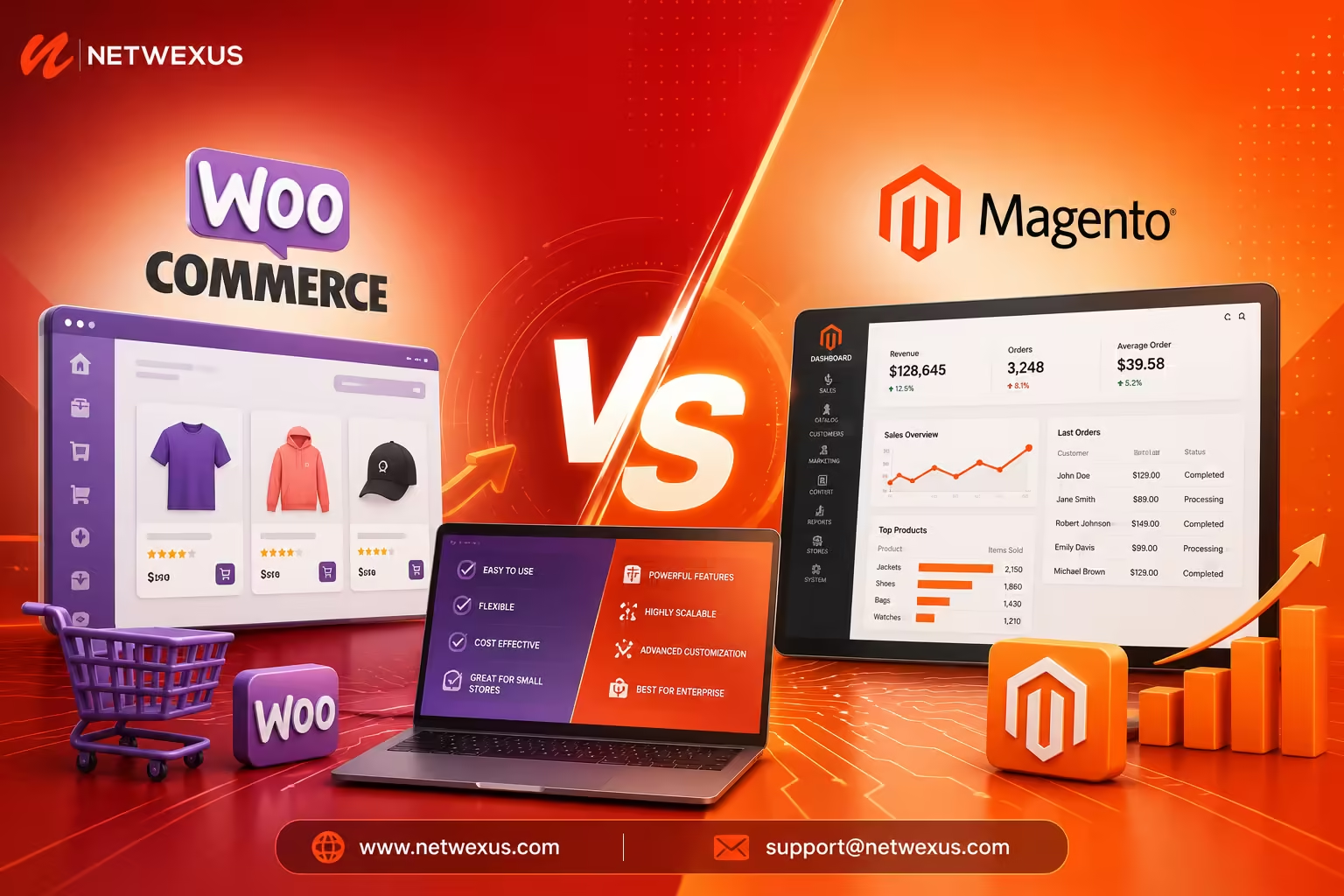
Choosing the right e-commerce platform can have a major impact on your online store’s performance, scalability, SEO visibility, security, and long-term growth. Two of the most recognized platforms for building online stores are WooCommerce and Magento.
Both platforms can support powerful e-commerce websites, but they are designed for different business needs. WooCommerce is known for its flexibility, WordPress integration, and relatively accessible setup, while Magento is built with advanced e-commerce functionality and scalability in mind.
So, which platform is better?
The answer depends on your business size, technical requirements, budget, product catalog, customization needs, and growth plans.
In this guide, Netwexus compares WooCommerce vs Magento across features, costs, SEO, performance, security, scalability, ease of use, and customization to help you choose the right platform for your online store.
WooCommerce vs Magento at a Glance
WooCommerce is an open-source e-commerce solution built for WordPress. It transforms a WordPress website into a fully functional online store and provides thousands of extensions and themes for customization.
Magento, now commonly associated with Adobe Commerce and Magento Open Source, is an e-commerce platform designed specifically for online retailers. It offers advanced catalog management, customer features, store management, and scalability.
Here is a quick comparison:
| Feature | WooCommerce | Magento |
|---|---|---|
| Ease of use | Excellent | Moderate to advanced |
| WordPress integration | Excellent | Not applicable |
| Customization | Excellent | Excellent |
| Small businesses | Excellent | Can be excessive |
| Large catalogs | Good to excellent | Excellent |
| Scalability | Excellent with proper setup | Excellent |
| SEO capabilities | Excellent | Excellent |
| Extensions | Extensive | Extensive |
| Development complexity | Lower | Higher |
| Hosting requirements | Moderate | Higher |
| Maintenance | Relatively easier | More technical |
| Enterprise features | Good | Excellent |
Neither platform is automatically better for every business. Your ideal choice depends on what you need from your store.
What Is WooCommerce?
WooCommerce is an open-source e-commerce plugin for WordPress. It allows businesses to sell physical products, digital products, subscriptions, services, memberships, and more.
One of WooCommerce’s biggest advantages is its integration with the WordPress ecosystem.
Businesses can combine their online store with WordPress content marketing, blogging, SEO tools, landing pages, lead generation, and other website functionality.
Key WooCommerce Features
WooCommerce offers features such as:
- Product and inventory management
- Shopping carts and checkout
- Payment gateway integration
- Shipping configuration
- Tax management
- Coupons and discounts
- Product variations
- Subscription functionality through extensions
- Customer accounts
- Order management
- Analytics and reporting
- Extensive third-party integrations
WooCommerce is particularly attractive to businesses that want control over their website without committing to a highly complex enterprise platform.
What Is Magento?
Magento is an e-commerce platform built specifically for online retail. Magento Open Source provides a powerful foundation for businesses that require advanced store functionality, while Adobe Commerce adds enterprise-level capabilities.
Magento is particularly well suited to businesses with complex product catalogs, multiple stores, advanced pricing structures, B2B requirements, and sophisticated operational workflows.
Key Magento Features
Magento provides capabilities including:
- Advanced catalog management
- Configurable and bundled products
- Multiple storefronts
- Multiple languages and currencies
- Customer segmentation
- Advanced pricing rules
- Inventory management
- Order management
- B2B functionality
- Extensive API capabilities
- Advanced checkout options
- Enterprise-level scalability
Magento can be extremely powerful, but that power often comes with increased development and maintenance requirements.
WooCommerce vs Magento: Features Compared
Features are one of the most important factors when selecting an e-commerce platform.
Product Management
WooCommerce provides straightforward product management through the WordPress dashboard. You can create simple, variable, downloadable, virtual, grouped, and other product types using extensions and configuration options.
Magento provides more advanced catalog management capabilities. It is designed to handle complex product structures, large catalogs, multiple product relationships, and sophisticated pricing requirements.
Winner for simplicity: WooCommerce
Winner for advanced catalog management: Magento
Payment Gateway Integration
Both platforms support major payment gateways.
WooCommerce can integrate with popular payment providers through plugins and extensions. This makes it relatively easy for businesses to add credit cards, digital wallets, bank transfers, and other payment methods.
Magento also supports extensive payment integrations, although implementing certain solutions may require professional development.
For businesses looking for straightforward payment integration, WooCommerce generally has the advantage.
Customization
Both WooCommerce and Magento are highly customizable.
WooCommerce benefits from the enormous WordPress ecosystem. Businesses can choose from thousands of themes and plugins and can modify the website through custom development.
Magento provides deep customization at the platform level. Developers can build complex functionality, custom modules, integrations, pricing rules, and business processes.
Winner for general flexibility: WooCommerce
Winner for complex e-commerce customization: Magento
WooCommerce vs Magento Cost
Cost is another major difference between the two platforms.
WooCommerce Costs
WooCommerce itself is open source, but running a professional WooCommerce store involves other expenses.
Potential costs include:
- Web hosting
- Domain registration
- Premium themes
- Paid plugins
- Payment processing
- Security services
- Development
- Maintenance
- SEO
- Performance optimization
A small WooCommerce store can often be launched with a relatively modest budget. Costs increase as the store requires advanced functionality, premium extensions, custom development, or high-performance hosting.
Magento Costs
Magento Open Source is also available without a traditional software license fee. However, Magento stores can require significantly more technical resources.
Potential costs include:
- High-performance hosting
- Magento development
- Custom modules
- Security management
- Maintenance
- Performance optimization
- Professional support
- Integrations
- Enterprise functionality
For larger businesses, Adobe Commerce can introduce substantially higher platform and implementation costs.
Which Is More Affordable?
For small and medium-sized businesses, WooCommerce is usually easier to launch and maintain within a limited budget.
Magento can make financial sense when the business needs advanced e-commerce functionality and has enough revenue or operational complexity to justify the investment.
Cost winner for most small businesses: WooCommerce
Best for complex enterprise requirements: Magento
WooCommerce vs Magento for SEO
SEO is critical for e-commerce businesses because organic search can generate consistent traffic, product discovery, and sales.
Both platforms can support strong SEO strategies.
WooCommerce SEO
WooCommerce benefits from the WordPress ecosystem and its large selection of SEO tools.
Store owners can optimize:
- Product titles
- Meta descriptions
- URLs
- Product categories
- Images
- Internal links
- Blog content
- Schema markup
- XML sitemaps
- Canonical URLs
- Breadcrumbs
WooCommerce also makes it easy to combine product pages with a content marketing strategy.
For example, an online store can publish buying guides, product comparisons, tutorials, and informational articles alongside product pages.
Magento SEO
Magento also provides strong SEO capabilities, including control over:
- Metadata
- URLs
- Canonical tags
- XML sitemaps
- Robots directives
- Structured data
- Category pages
- Product pages
- Layered navigation
Magento can perform extremely well in search engines when properly configured.
However, advanced Magento stores can require careful SEO management because large catalogs, filters, parameters, duplicate content, and complex navigation structures can create technical SEO challenges.
SEO Winner
There is no universal winner.
WooCommerce is often easier for businesses that prioritize content marketing and straightforward SEO management.
Magento is powerful for large stores with complex SEO requirements, but it typically requires more technical expertise.
Ultimately, the quality of your technical SEO, content, site architecture, performance, and ongoing optimization matters more than simply choosing one platform.
WooCommerce vs Magento Performance
Website performance affects user experience, conversions, and SEO.
A slow e-commerce store can increase abandonment and make it harder for customers to browse products.
WooCommerce Performance
WooCommerce performance depends heavily on:
- Hosting quality
- WordPress configuration
- Theme quality
- Plugin quantity
- Database optimization
- Image optimization
- Caching
- CDN configuration
- JavaScript and CSS optimization
A properly optimized WooCommerce store can handle significant traffic and large product catalogs.
However, poorly configured plugins, excessive scripts, inefficient themes, and weak hosting can slow down a WooCommerce website.
Magento Performance
Magento is designed for sophisticated e-commerce environments, but it also has higher server and development requirements.
Performance optimization may involve:
- Advanced caching
- Database optimization
- CDN implementation
- Image optimization
- PHP configuration
- Server tuning
- Code optimization
- Elasticsearch/OpenSearch configuration
- Full-page caching
Magento can deliver excellent performance at scale when properly configured.
Performance Winner
For a small or medium store with a properly optimized setup, WooCommerce can provide excellent performance with fewer infrastructure requirements.
For complex, high-volume stores, Magento can be a stronger choice when supported by experienced developers and appropriate infrastructure.
Scalability: WooCommerce vs Magento
Scalability refers to how well your platform handles increasing products, customers, traffic, transactions, and operational complexity.
WooCommerce can scale significantly when properly developed and hosted. Large WooCommerce stores may require database optimization, high-performance hosting, object caching, CDN integration, and careful plugin management.
Magento was built with larger and more complex e-commerce operations in mind. Its architecture makes it particularly attractive to businesses managing extensive catalogs, multiple storefronts, complicated pricing, and high transaction volumes.
Scalability winner for complex enterprise environments: Magento
Scalability winner for flexible growth with lower complexity: WooCommerce
Security Comparison
Security should be a priority regardless of which platform you choose.
WooCommerce security depends on WordPress core, WooCommerce, themes, plugins, hosting, passwords, updates, and server configuration.
Magento also requires regular updates, secure hosting, access controls, monitoring, and professional maintenance.
Businesses should implement:
- SSL certificates
- Strong administrator passwords
- Multi-factor authentication where available
- Regular backups
- Security monitoring
- Software updates
- Secure hosting
- Limited administrator permissions
- Malware monitoring
- Firewall protection
Neither platform should be considered automatically secure simply because it is a popular platform.
Ease of Use
WooCommerce generally has a lower learning curve because it operates within WordPress.
Business owners familiar with WordPress can usually understand the basic WooCommerce dashboard relatively quickly.
Magento is more complex. Its extensive functionality can be an advantage for professional e-commerce teams, but it can be overwhelming for beginners.
Ease-of-use winner: WooCommerce
If your team does not have technical developers, WooCommerce is generally the easier platform to manage.
WooCommerce vs Magento: Which Is Better for Small Businesses?
For many small businesses, WooCommerce is the more practical choice.
It offers:
- Lower initial complexity
- WordPress integration
- Large plugin ecosystem
- Flexible design options
- Accessible content management
- Strong SEO potential
- Easy blogging
- Broad payment integration
- Lower development barriers
A small business does not necessarily need the complexity of Magento.
Which Is Better for Large E-commerce Businesses?
Large businesses with complex operational requirements may benefit from Magento.
Magento becomes attractive when you need:
- Large product catalogs
- Multiple storefronts
- Advanced product structures
- Complex pricing
- B2B functionality
- Multiple currencies
- Advanced customer management
- Sophisticated integrations
- Enterprise-level scalability
However, businesses should have the budget and technical resources necessary to operate the platform effectively.
WooCommerce vs Magento: Pros and Cons
WooCommerce Pros
- Easy to learn
- WordPress integration
- Extensive plugin ecosystem
- Strong SEO potential
- Flexible customization
- Suitable for small and medium businesses
- Large developer community
- Excellent content marketing capabilities
WooCommerce Cons
- Plugin conflicts can occur
- Performance requires optimization
- Large stores need careful infrastructure planning
- Some advanced features require paid extensions
- Security requires ongoing maintenance
Magento Pros
- Powerful e-commerce functionality
- Excellent scalability
- Advanced catalog management
- Multi-store capabilities
- Strong customization
- Suitable for complex business models
- Enterprise-level capabilities
Magento Cons
- Higher technical complexity
- More demanding hosting requirements
- Higher development costs
- Requires experienced developers
- Maintenance can be more complicated
- Not always practical for small businesses
WooCommerce vs Magento: Final Verdict
So, which platform should you choose?
The answer depends on your business.
Choose WooCommerce if you want a flexible, SEO-friendly, cost-effective e-commerce platform that integrates with WordPress and is relatively easy to manage.
Choose Magento if your business requires advanced e-commerce functionality, complex product catalogs, multiple storefronts, sophisticated pricing, B2B capabilities, or enterprise-level scalability.
For most startups and small-to-medium businesses, WooCommerce provides an excellent balance between functionality, cost, flexibility, and usability.
For larger organizations with complex e-commerce operations and professional development resources, Magento can provide the advanced capabilities needed to support long-term growth.
Need Help Choosing Between WooCommerce and Magento?
Selecting an e-commerce platform is only the first step. Your store also needs a fast design, strong technical foundation, SEO-friendly architecture, secure integrations, optimized hosting, and ongoing maintenance.
Netwexus provides professional WooCommerce development, Magento development, e-commerce website development, SEO, website design, and digital marketing services to help businesses build scalable online stores.
Whether you are launching a new e-commerce website, redesigning an existing store, migrating platforms, or improving your SEO and performance, choosing the right technology and implementation strategy can make a significant difference.
Ready to build or improve your online store? Contact Netwexus to discuss your e-commerce development requirements.