Internal links are one of the few SEO levers you fully control. They help Google discover your pages, understand how your content fits together and decide which pages matter most. They also guide visitors from one useful page to the next, which keeps them on your site longer.
This guide explains internal linking for SEO, the best practices that work in 2026 and a simple process to improve the links on your own website.
What Are Internal Links?
An internal link is a link from one page on your website to another page on the same website. Menus, footers, buttons, breadcrumbs and links inside your content are all internal links. The most valuable for SEO are usually contextual links placed naturally inside your page content.
Why Internal Linking Matters for SEO
- Discovery: Google finds new pages by following links. Pages with no internal links, called orphan pages, may be crawled rarely or not at all.
- Context: Anchor text tells Google what the linked page is about.
- Priority: Pages that receive more internal links are signaled as more important.
- Authority flow: Strong pages, such as those with many backlinks, can pass value to related pages.
- User experience: Helpful links answer the next question a reader has.
Internal Linking Best Practices
1. Use Descriptive Anchor Text
Write anchor text that describes the destination, such as “local SEO services” instead of “click here”. Keep it natural and varied; do not force the exact same keyword everywhere.
2. Link From Strong Pages to Important Pages
Your homepage, popular blog posts and pages with backlinks carry the most authority. Use them to link to the service pages you most want to rank.
3. Build Topic Clusters
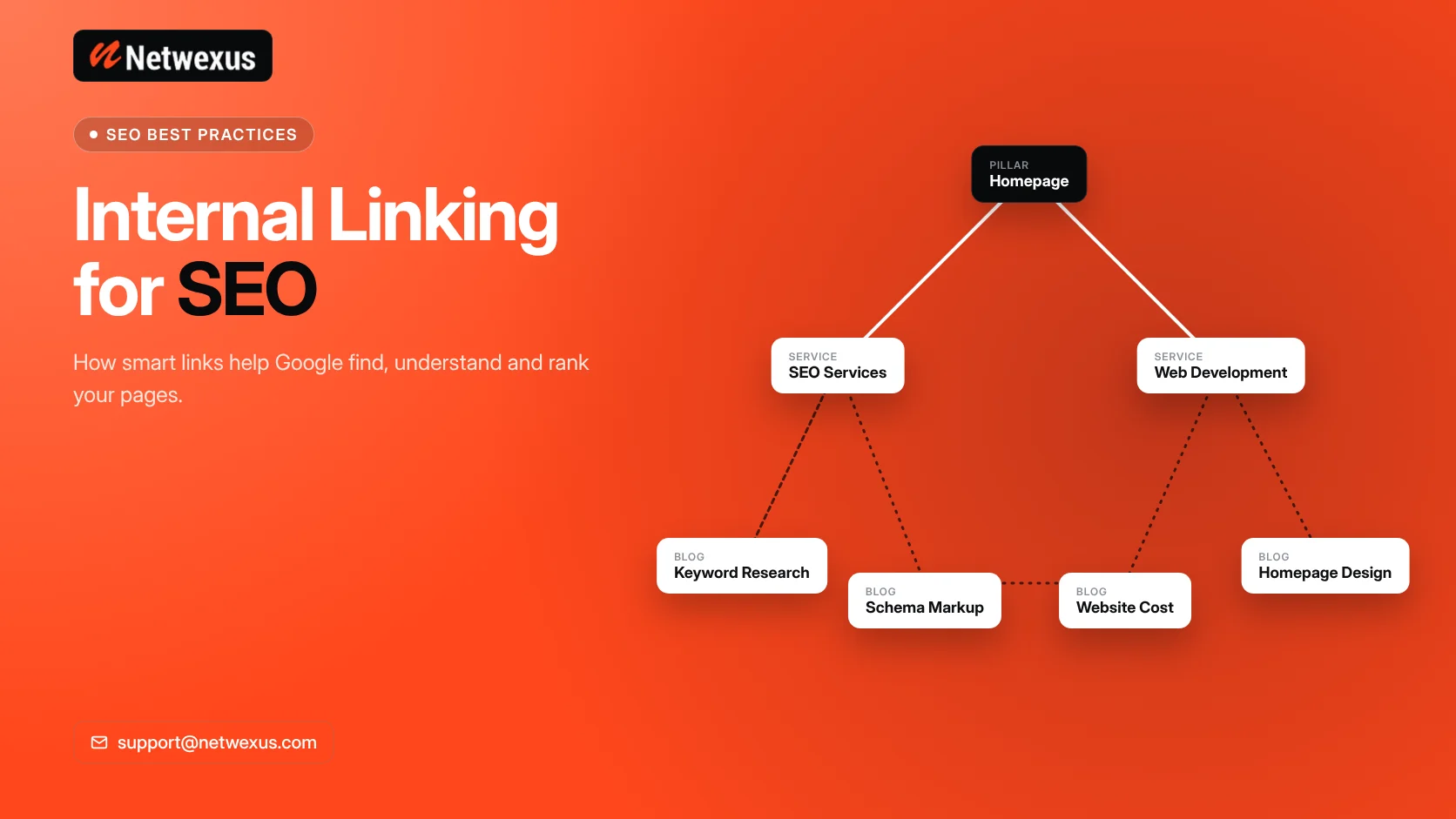
Create a main pillar page for each core topic and support it with related articles. Link each article to the pillar and the pillar back to each article. For example, a SEO services page can link to guides on keyword research, schema and technical SEO.
4. Link Deeply, Not Just to the Homepage
Most of your content links should point to specific service, product and article pages, not your homepage or contact page.
5. Keep Important Pages Close to the Homepage
Key pages should be reachable within about three clicks of the homepage.
6. Fix Broken Links and Redirect Chains
Update internal links that point to deleted pages or redirects, so users and crawlers go straight to the final URL.
7. Add Links When You Publish
Every new article should link to related existing pages, and a few older pages should be updated to link to the new one.
8. Use a Reasonable Number of Links
There is no magic number. Add links where they genuinely help the reader, without turning paragraphs into lists of links.
A Simple Internal Linking Process
- List your most important pages: services, top products and pillar content.
- Crawl your site with a tool such as Screaming Frog to find orphan pages and broken links.
- Use a Google search like
site:yourdomain.com keywordto find pages that mention a topic but do not link to its main page. - Add contextual links with descriptive anchor text.
- Check Google Search Console’s Links report to confirm your priority pages receive the most internal links.
Common Internal Linking Mistakes
- Orphan pages that no other page links to.
- Generic anchors like “read more” or “here” everywhere.
- Linking only through menus with no contextual links.
- Too many site-wide footer links, which dilute focus.
- Linking several pages with the same anchor text, which confuses which page should rank.
Frequently Asked Questions
Do internal links help rankings?
Yes. They help Google discover and understand pages and signal which ones are most important, which supports better rankings.
Should internal links open in a new tab?
Generally no. Internal links should open in the same tab, which is what most users expect.
Are nofollow internal links useful?
Rarely. Internal links should usually be followed so Google can crawl your site normally.
Strengthen Your Site Structure
A smart internal linking plan is part of every SEO project we run. Explore our on-page SEO services, our technical SEO services or request a free quote.