
- September 12, 2026
- 0 Comments
For modern colleges and higher education institutions, the website is no longer an auxiliary marketing channel or an online archive of course catalogs. It is the institution’s primary front door, flagship campus tour, and recruitment pipeline rolled into one.
Before a prospective student steps foot on campus, attends an open house, or speaks with an admissions counselor, they have already scrutinized your institution online. They have evaluated your academic programs, checked your campus culture on their smartphones, compared your tuition transparency against competing colleges, and formed an immediate emotional impression of your brand.
If that digital experience feels sluggish, confusing, fragmented, or inaccessible, prospective learners do not hunt through legacy navigation menus to find answers—they leave. Every bounced visitor is a lost inquiry, an abandoned application, and lost tuition revenue.
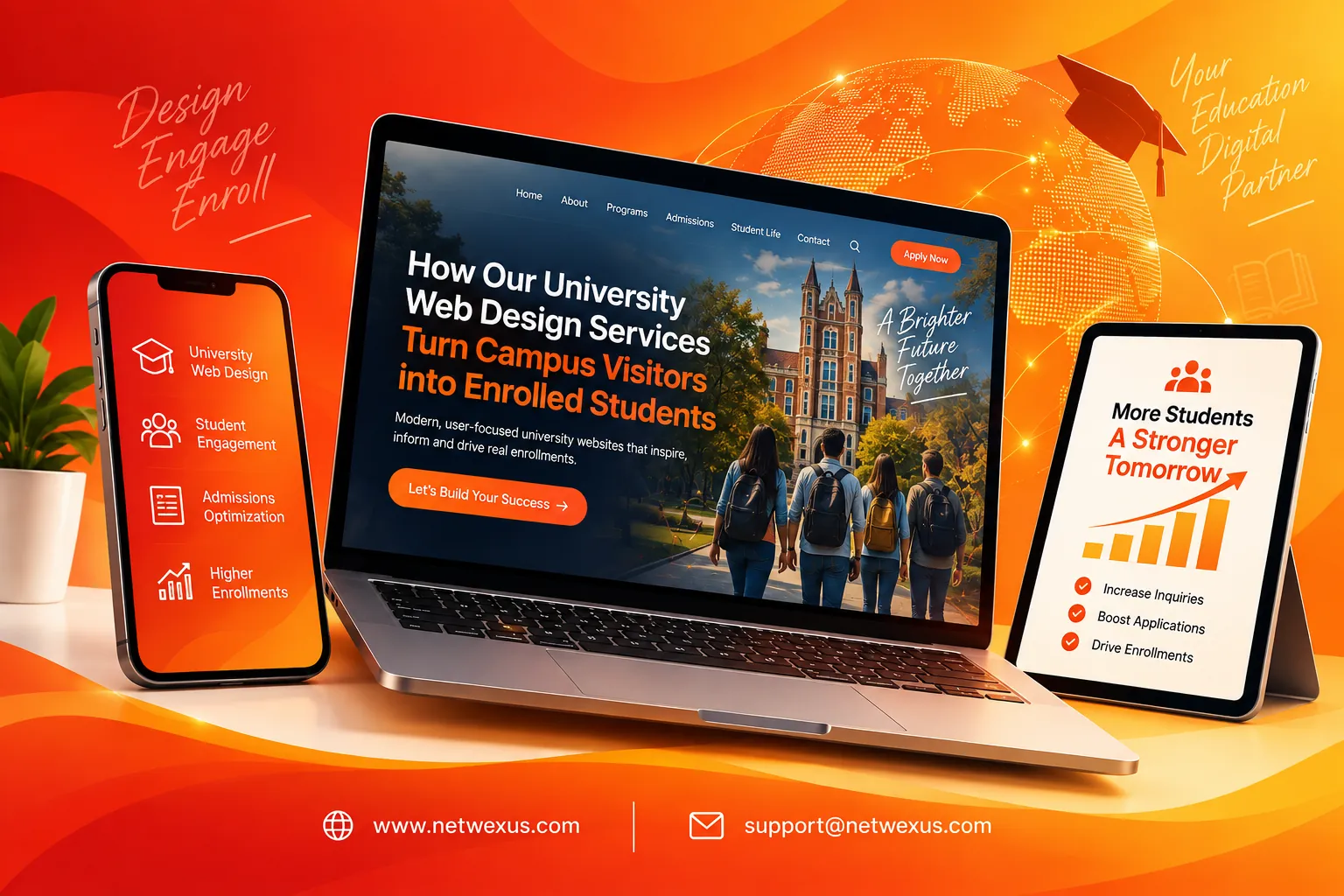
Transforming casual campus website visitors into enrolled, matriculated students requires moving beyond passive “digital brochures.” It demands an intentionally engineered, conversion-focused digital ecosystem. Here is an in-depth breakdown of how our specialized university web design and development services turn digital traffic into qualified applications and growing enrollment cohorts.
The Shifting Higher Education Landscape: Why Traditional College Websites Fail
For decades, higher education websites were structured to serve internal administrative silos rather than the prospective student journey. Academic departments, faculty governance, alumni relations, research bodies, and student affairs competed for valuable homepage real estate. The result was a convoluted maze of institutional jargon, multi-level dropdowns, broken links, and hidden PDFs.
Today’s prospective undergraduate and graduate students have zero tolerance for digital friction. Raised in an era of seamless digital experiences defined by platforms like Spotify, Apple, and Airbnb, Gen Z and non-traditional adult learners expect:
Instant answers to core questions (programs offered, total cost of attendance, career placement outcomes).
Frictionless mobile navigation designed specifically for handheld, single-thumb browsing.
Clear, non-intimidating pathways to take the next step toward enrollment.
When an academic website reflects bureaucratic internal divisions instead of user-centered information architecture, bounce rates skyrocket. Our university web design services address this fundamental disconnect by rebuilding the digital experience around the prospective student’s psychology and decision-making cycle.
Architecting Student-Centric Information Architecture (IA)
The primary reason prospective applicants leave an academic site without taking action is information fatigue. When faced with dozens of parent categories and ambiguous academic labels, visitors experience analysis paralysis.
Our design process begins with a comprehensive audit and restructuring of your institution’s information architecture. We replace bloated hierarchies with clean, purpose-driven navigation models:
Task-Based Navigation: Primary navigation menus are categorized by visitor intent (Academics, Admissions & Aid, Campus Life, Visit) rather than administrative governance.
Audience-Specific Gateways: Dedicated entry paths allow distinct user groups—such as undergraduate prospects, transfer students, international applicants, graduate candidates, and parents—to self-select and reach tailored recruitment messaging instantly.
The “Three-Click Rule” of Higher Ed: Every core detail—from prerequisite courses and tuition calculators to financial aid deadlines—is structured to be discoverable within three clicks of the homepage.
By stripping away administrative clutter, prospective students quickly find the academic opportunities that match their personal aspirations.
Interactive Program & Degree Finders: The Engine of Academic Discovery
When students land on your website, their single most urgent question is: “Do you have the major or program I want, and is it worth my investment?”
Burying programs inside alphabetical text lists or static PDF handbooks kills user engagement. We engineer custom, faceted Program and Degree Finders that act as the centerpiece of academic recruitment.
Key Capabilities of Our Custom Program Finders:
Real-Time Dynamic Filtering: Visitors can instantly sort through hundreds of offerings by degree type (Bachelor’s, Master’s, Doctoral, Minors, Professional Certificates), delivery format (On-Campus, 100% Online, Hybrid), and academic area of interest.
Predictive Keyword Search: As users type, results update dynamically, accommodating varied terminology (e.g., matching “Coding” or “Software” to “Computer Science”).
Scannable Program Cards: Search results display high-priority summary cards showcasing degree level, department, fast facts, and direct links to apply or request information.
Integrated Career Outcomes: Each dedicated program page directly answers ROI questions by highlighting median starting salaries, industry internship partners, alumni employers, and faculty mentorship highlights.
By transforming a dry course list into an engaging discovery tool, visitors spend more time exploring programs and develop stronger confidence in your academic value.
Micro-Conversions: Guiding Prospects Down the Admissions Funnel
A common misstep in university web design is relying solely on high-commitment calls to action. Prominently splashing a bold “Apply Now” button on every page rarely works for early-stage prospects.
An eighteen-year-old exploring options during junior or senior year of high school—or a working professional researching part-time master’s degrees—is rarely ready to complete a lengthy, multi-step application during their first visit. Pushing only for the final application creates friction and causes visitors to abandon the site without leaving a trace.
We design a multi-tiered conversion framework that captures leads across every stage of the recruitment funnel:
[ Top of Funnel ] Interactive Virtual Tours & Campus Life Video Walkthroughs ↓
[ Middle of Funnel ] Downloadable Major Guides, Curriculum Syllabi & Tuition Calculators ↓
[ High Intent ] 1-Click Campus Visit Scheduling & Counselor Chat ↓
[ Bottom of Funnel ] Streamlined, Frictionless "Apply Now" Portals
Strategic Micro-Conversion Touchpoints:
Low-Friction Inquiry Forms: Short, contextual “Request Info” forms embedded directly on program pages, asking only for essential fields (Name, Email, Start Term, Program of Interest).
Downloadable Program Previews: Prospects trade an email address for a rich, downloadable PDF detailing career trajectories, internship opportunities, and sample semester schedules.
One-Click Tour Scheduling: Seamless integration with calendar tools allowing prospective students and parents to book in-person campus visits or virtual webinars without navigating external, disjointed portals.
Capturing student contact data early allows your admissions team to nurture relationships through targeted email drip campaigns long before the official application deadline closes.
Mobile-First UX Built for Gen Z and Non-Traditional Learners
Modern enrollment strategy requires designing for smartphones first, not as an afterthought. More than 70% of prospective undergraduate web traffic originates from mobile devices. If forms do not autocomplete smoothly, if fonts are illegible, or if key navigation links are difficult to tap, your admissions pipeline suffers immediate drop-offs.
Our mobile engineering philosophy focuses on thumb-zone usability and speed:
Persistent Bottom Utility Bars: Key conversion triggers (Inquire, Visit, Apply) remain accessible along the bottom of the mobile viewport, allowing immediate action without endless scrolling.
Touch-Friendly Accordions & Carousels: Dense academic curricula and degree requirements are organized within clean, expandable mobile modules that keep page lengths manageable.
Sub-Two-Second Core Web Vitals: We implement next-generation image formatting (WebP/AVIF), lightweight CSS/JS architectures, server-side caching, and asynchronous asset loading to ensure sub-two-second load times over variable mobile data connections.
A fast, responsive mobile site communicates that your university is technologically progressive, modern, and student-focused.
Accessible, Inclusive Design: Compliance Meets Broadened Reach
In higher education, digital accessibility is not merely an aesthetic choice—it is a moral imperative and a legal requirement under federal and international frameworks, including ADA Title II/III and WCAG 2.1 AA standards.
An inaccessible website alienates talented learners with disabilities and exposes institutions to costly compliance reviews. We embed accessibility into every stage of the design and development lifecycle:
| Accessibility Dimension | Practical Implementation in Our University Builds | Direct Enrollment Impact |
| Color Contrast Ratios | Strict compliance with WCAG AAA/AA 4.5:1 text-to-background contrast requirements. | Ensures readability in varied lighting conditions for all prospective applicants. |
| Keyboard Navigability | Logical DOM structure, visible focus outlines, and skip-to-content anchors. | Enables power users and assistive technology users to navigate application steps smoothly. |
| Screen Reader Optimization | Semantic HTML5 tags (<main>, <nav>, <article>), descriptive ARIA labels, and informative alt text. | Guarantees visually impaired candidates receive complete, context-rich academic information. |
| Accessible Form Design | Explicit label tags, persistent error validation, and screen-reader-friendly status alerts. | Eliminates form abandonment caused by confusing form errors during lead submission. |
By prioritizing accessible, inclusive design, your university welcomes every qualified candidate and demonstrates institutional commitments to diversity, equity, and inclusion from the very first click.
Seamless CRM and Admissions Tech Stack Integrations
A high-converting website cannot live on an island; it must function as a seamless extension of your university’s administrative and marketing engine. If prospective student leads sit dormant in an isolated web database, recruitment momentum vanishes.
Our development team builds custom API bridges and robust webhooks connecting your front-end web portal directly into industry-standard higher education Customer Relationship Management (CRM) and Student Information Systems (SIS):
Higher Ed CRM Syncing: Direct integration with platforms such as Slate (Technolutions), Salesforce Education Cloud, HubSpot, and Ellucian Banner/Colleague.
Automated Lead Routing: As soon as an inquiry form is submitted, the prospect’s record is automatically created, tagged with their chosen major and intended enrollment term, and routed to the corresponding regional admissions counselor.
Closed-Loop Analytics Tracking: We establish robust tracking infrastructures using Google Analytics 4 (GA4) and server-side tag management. This provides your board, CMO, and admissions dean with transparent attribution data: identifying exactly which paid search campaigns, organic search terms, and web pages generate high-value matriculated students.
Authentic Storytelling: Turning Campus Culture into an Emotional Hook
Data and rankings matter, but college decisions are fundamentally emotional. Prospective students choose an institution where they can envision their future, forge lifelong friendships, and find a sense of belonging.
Stock photography and dry institutional statements fail to resonate with modern audiences. Our design methodology elevates genuine campus storytelling directly into recruitment funnels:
Authentic Student Journeys: We integrate micro-video testimonials, day-in-the-life features, and student-produced content directly beside academic program requirements.
Interactive Campus Maps & Virtual Immersion: High-fidelity 360-degree photography, interactive drone perspectives, and curated campus walking routes allow remote and international applicants to experience your facilities from anywhere in the world.
Live Social Proof Feeds: Curated social media integrations show prospective applicants what is happening on campus in real time—from research symposia to athletic events and student organization activities.
When prospective students connect emotionally with your campus narrative, their motivation to complete the application process increases substantially.
Data-Driven Continuous Optimization Post-Launch
Launching your redesigned university website is not the finish line—it is the baseline for ongoing enrollment growth. Student behavior evolves, recruitment priorities shift, and digital trends move rapidly.
Our agency partners with higher education institutions for long-term growth through continuous performance tracking and conversion rate optimization (CRO):
Heatmapping & User Session Analysis: We review interaction maps and recorded browsing sessions to identify pages where users hesitate, stall, or drop off before completing an inquiry.
A/B Testing Key Funnels: We systematically test variations of inquiry forms, headline copy, CTA placements, and program finder interfaces to steadily lift conversion percentages semester over semester.
Continuous Accessibility & Performance Audits: Regular automated scans protect against code regressions, maintaining strict regulatory compliance and peak page speed as new staff members add departmental content.
Transform Your Website into Your Strongest Recruitment Asset
A university website should never be an expensive, static business card that collects dust between multi-year redesign cycles. Engineered properly, it is your institution’s most cost-effective recruitment tool—working around the clock to attract global talent, showcase academic distinction, and deliver qualified, motivated applicants directly to your admissions team.
If your institution is dealing with stagnating enrollment numbers, declining lead quality, high bounce rates, or an outdated mobile experience, our team brings the specialized higher education expertise required to modernize your digital presence.
Contact our higher education web design team today to schedule an in-depth website and conversion audit, and discover how a strategic digital transformation can drive your next record-breaking enrollment season.