A business website is no longer simply an online brochure. It is often the first place potential customers interact with a company, research its services, compare alternatives, and decide whether to make contact. That means a successful website needs to do more than look professional. It needs to be technically sound, easy to use, fast, mobile-friendly, search-engine friendly, and designed around business goals.
This is where choosing an agency that provides both website development and SEO services can make a significant difference.
Many businesses approach website development and search engine optimization as two completely separate projects. A developer builds the website, the site goes live, and SEO is considered later. While this approach can work, it can also create unnecessary technical problems, additional costs, and delays when SEO requirements need to be retrofitted into an existing website.
An integrated approach brings development and SEO together from the beginning. The result can be a stronger digital foundation where design, functionality, technical performance, search visibility, and conversions work toward the same objectives.
What Does a Website Development and SEO Agency Do?
An agency offering both web development and SEO can handle the relationship between how a website is built and how it needs to perform in search engines.
Website development focuses on the technical and visual foundation of a website. This includes its design, functionality, content management system, responsiveness, integrations, security, and overall user experience.
SEO focuses on making that website easier for search engines to understand while improving its ability to attract relevant organic visitors.
When these disciplines are integrated, SEO considerations can influence development decisions from the beginning.
For example, an SEO-friendly website development process may consider:
- Website architecture and navigation
- Search-friendly URL structures
- Mobile responsiveness
- Page loading performance
- Internal linking
- Metadata and content structure
- Image optimization
- Crawlability and indexability
- Technical SEO
- Conversion-focused page layouts
- Analytics and tracking
This does not mean every developer needs to become an SEO strategist or that every SEO professional needs to be a developer. Instead, the advantage comes from having the two disciplines coordinated within the same project.
Netwexus, for example, combines WordPress design and development with SEO-focused services, including technical SEO, keyword research, on-page SEO, local SEO, and SEO audits.
Why Website Development and SEO Should Work Together
SEO should ideally begin before a website launches, not several months afterward.
Imagine a company launches a new website with an attractive design but discovers later that its navigation is difficult for search engines to crawl, important pages have poor URL structures, images are unnecessarily large, or the site performs poorly on mobile devices.
An SEO agency can identify and address many of these problems, but fixing them after launch may require changes to the original development work.
An integrated approach allows businesses to consider SEO during planning and development.
Website Architecture
The structure of a website affects both visitors and search engines.
A logical hierarchy makes it easier for users to find information and helps search engines understand relationships between pages. Important services should be easy to reach, while related content should be connected through sensible internal links.
Page Speed and Performance
A visually impressive website can still provide a poor experience if it takes too long to load.
Website development plays an important role in performance through choices involving code, plugins, images, hosting, scripts, caching, and page builders.
Performance optimization should therefore be considered part of the development process rather than something added only after a website becomes slow.
Mobile Responsiveness
A modern website needs to work effectively across smartphones, tablets, laptops, and desktop computers.
Responsive development ensures that layouts, navigation, buttons, images, forms, and content adapt to different screen sizes.
Mobile usability also matters from an SEO perspective because search engines evaluate websites based on their ability to provide a good experience across devices.
Crawlability and Indexability
Search engines need to be able to discover, crawl, and understand the important pages on a website.
Technical issues involving navigation, robots directives, canonical URLs, broken links, redirects, or indexing can prevent important pages from performing as expected.
Building with these considerations in mind can reduce technical SEO problems later.
Content and Internal Linking
SEO-friendly development should accommodate content rather than treating content as an afterthought.
Service pages, location pages, product pages, and educational content should have logical relationships. Internal links can then connect relevant pages and help users move naturally through the website.
Schema Markup
Depending on the website and content, structured data can help search engines better understand information such as products, organizations, services, articles, and other entities.
Schema should be implemented appropriately rather than added simply because it is an SEO trend.
Problems With Hiring Separate Web Development and SEO Companies
There is nothing inherently wrong with hiring separate specialists. In some cases, a business may intentionally choose a specialist developer and an independent SEO consultant.
The challenge is coordination.
Communication Gaps
When development and SEO teams work independently, important recommendations can be lost between teams.
An SEO specialist may request a technical change while the development team has already finalized the architecture.
Conflicting Recommendations
A developer may prioritize a particular feature, plugin, or design element while an SEO professional may recommend a different approach for performance or crawlability.
Without clear coordination, businesses have to act as the middleman.
SEO Being Considered Too Late
One of the biggest challenges is treating SEO as a post-launch activity.
Changing website architecture, page structures, URLs, templates, and technical elements after development can be more complicated than incorporating them during the original build.
Duplicate Work
Businesses may end up paying two teams to investigate the same issues or repeatedly explain the same business requirements.
An integrated agency can potentially simplify project management by bringing the relevant skills together.
Higher Overall Costs
Separate services do not necessarily cost more, but inefficient communication, repeated work, technical fixes, and redesigns can increase the total project investment.
The goal should not simply be to find the cheapest provider. It should be to find a team capable of delivering the right solution efficiently.
What to Look for in a Website Development Agency With SEO Services
Choosing an agency requires more than checking whether “SEO” and “web development” appear on its services page.
Look for evidence that the two disciplines actually work together.
1. SEO-Friendly Website Architecture
Ask how the agency plans your navigation, URLs, page hierarchy, internal linking, and content structure.
2. Responsive Design
The website should provide a consistent and usable experience across devices.
3. Website Speed Optimization
Ask how the agency approaches images, scripts, caching, hosting, code, plugins, and other performance factors.
4. Technical SEO
A capable team should understand areas such as crawlability, indexability, redirects, canonicalization, XML sitemaps, structured data, and technical audits.
5. Keyword Research and On-Page SEO
The website should be structured around the topics and search queries that matter to the target audience.
6. Local SEO
For businesses serving specific locations, the agency should understand local search optimization, location-based pages, business information, and other local SEO considerations.
7. Conversion Optimization
Getting visitors to a website is only part of the objective.
The site should make it easy for visitors to call, submit a form, request a quote, purchase a product, schedule an appointment, or take another meaningful action.
8. Analytics and Tracking
Ask how the agency measures website performance.
Depending on the business, useful measurements may include organic traffic, engagement, leads, sales, form submissions, rankings, and conversions.
9. CMS Expertise
If you are using WordPress, Shopify, or another CMS, choose an agency with practical experience in that platform.
Netwexus, for example, specializes in WordPress development and also provides WooCommerce solutions, making its services relevant to both standard business websites and online stores.
10. Ongoing Support
A website is not necessarily finished when it launches.
Security updates, performance improvements, technical fixes, content changes, SEO improvements, and new functionality may be required over time.
How Integrated Services Can Improve Website Performance and SEO
Website performance, SEO, user experience, and conversions are closely connected.
Consider a local service business that launches a beautiful website. Visitors can find the business through search, but the service page loads slowly, the contact button is difficult to find on mobile, and the navigation contains too many unnecessary options.
The problem is not simply SEO.
It is the entire digital experience.
An integrated team can look at the website from multiple perspectives:
Search: Can search engines discover and understand the page?
Performance: Does the page load efficiently?
Experience: Can visitors quickly find what they need?
Conversion: Is the next action obvious?
Business: Does the website support the company’s actual goals?
This broader perspective is particularly valuable when a business is investing in both a new website and long-term organic growth.
Website Development and SEO for Different Types of Businesses
The right strategy depends on the business model.
Local Businesses
A local business may need a website optimized around its services and geographic market. Local SEO, location-specific content, mobile usability, reviews, contact information, and clear conversion paths can all be important.
Professional Services
Law firms, consultants, agencies, accountants, healthcare businesses, and other professional service providers often need strong service pages that establish expertise and make it easy for potential clients to request information.
E-commerce Stores
E-commerce websites require additional considerations, including product architecture, category pages, filters, product content, technical performance, mobile shopping, and conversion optimization.
SEO and development need to work together so that search engines can efficiently discover valuable products and categories without creating unnecessary technical complexity.
Startups
Startups often need a website that can evolve as the business grows.
A scalable architecture can make it easier to add services, content, integrations, landing pages, and new functionality without rebuilding the entire website.
B2B Companies
B2B websites often have longer customer journeys.
A strong website may need service pages, industry-specific content, case studies, resources, lead-generation forms, and educational articles that support potential customers throughout the research process.
Questions to Ask Before Choosing an Agency
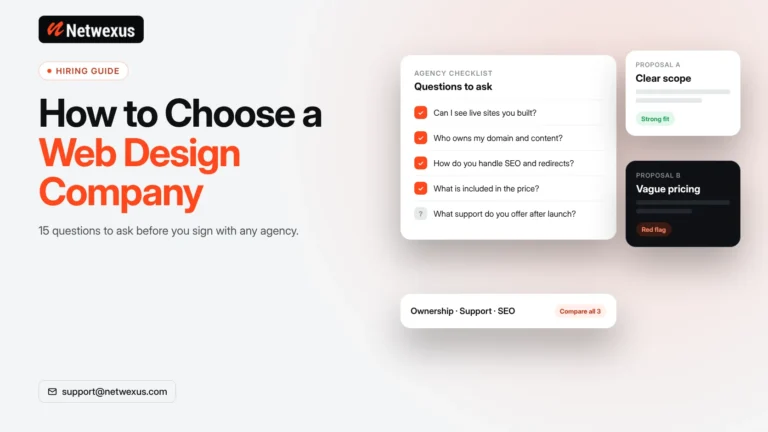
Before hiring a website development company, ask questions that reveal how development and SEO will work together.
Do you build websites with SEO in mind?
The agency should be able to explain how SEO influences its development process.
Who handles technical SEO?
Find out whether technical SEO is handled internally or outsourced.
How do you approach website architecture?
Ask how the agency plans navigation, URLs, content hierarchy, and internal linking.
Do you provide ongoing SEO?
If organic growth is important, understand what happens after launch.
How do you measure SEO performance?
A professional agency should be able to explain which metrics it monitors and why those metrics matter to your business.
Can you optimize an existing website?
If you already have a website, ask whether the agency can audit, redesign, develop, and optimize the existing platform rather than automatically recommending a complete replacement.
How do you approach Core Web Vitals and page speed?
Ask what practical steps the team takes to improve website performance.
Do you provide analytics and reporting?
Clear reporting helps businesses understand what has been changed, what is improving, and what should happen next.
Why Choose Netwexus?
Choosing the right partner ultimately comes down to how well an agency understands your business goals and connects development with measurable digital outcomes.
Netwexus positions itself as a WordPress design and development agency focused on fast, responsive, conversion-ready websites. Its current service offering includes WordPress development, website redesign, eCommerce development, maintenance, and search engine optimization.
Its SEO offering includes areas such as keyword research, on-page SEO, technical SEO, SEO audits, link building, local SEO, and eCommerce SEO.
That combination can be particularly useful for businesses that do not want website development and SEO treated as completely disconnected projects.
Whether a company needs a new WordPress website, a redesign, an eCommerce store, or ongoing optimization, the objective should be the same: create a website that provides a strong user experience while establishing a foundation for sustainable organic growth.
The right agency should also be willing to understand the business before recommending technology or SEO tactics. A website should be built around the audience, services, competitive environment, and conversion goals—not simply around a list of technical features.
Conclusion
Finding the right website development and SEO services provider can make the process of building and growing a business website more coordinated.
Website development determines much of the foundation: architecture, performance, responsiveness, functionality, usability, and scalability. SEO helps that foundation become more discoverable and relevant to people searching for the products or services a business provides.
When these areas are planned together, businesses can reduce the risk of building a website that needs significant SEO-related changes later.
That does not mean every company must use one agency for everything. What matters most is expertise, communication, strategy, transparency, and the ability to connect technical decisions with business objectives.
If you are planning a new website, redesigning an existing site, or looking for a stronger foundation for organic growth, consider working with an agency that understands both web development and SEO.