
- September 7, 2026
- 0 Comments
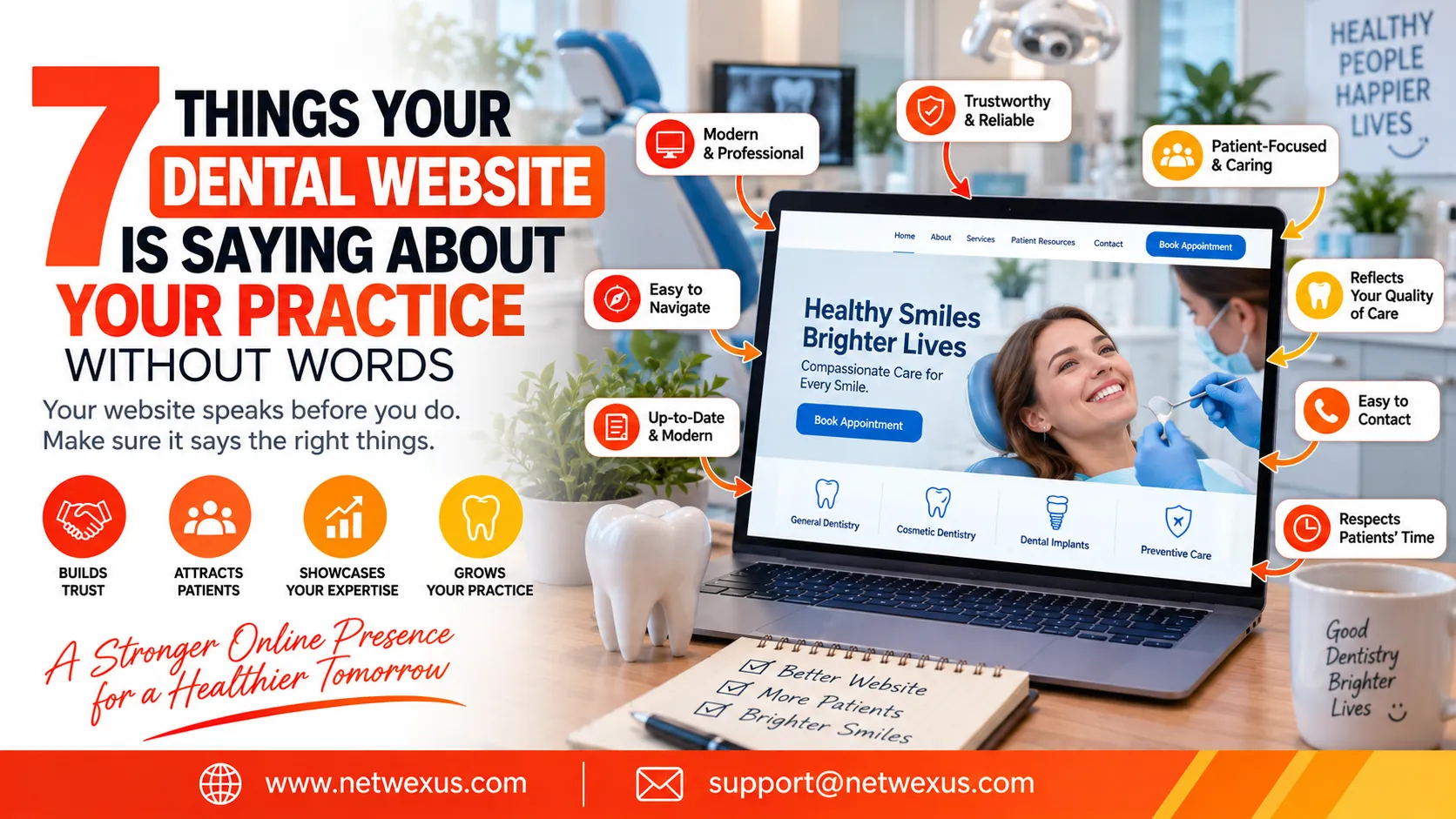
Your dental website speaks before your receptionist answers the phone, before a patient walks through your doors, and sometimes before they even read a single sentence. The colors, photographs, page layout, loading speed, navigation, typography, and overall experience all communicate something about your dental practice.
For potential patients, these details can influence an important decision: Should I trust this practice with my dental care?
A website does not have to explicitly say that a dental practice is professional, modern, trustworthy, caring, or reliable. Its design can communicate those qualities without words. On the other hand, an outdated or confusing website can unintentionally create the opposite impression.
This is why dental website design is about much more than making a website visually attractive. It is about creating a digital experience that reflects the quality and personality of the practice.
Here are seven things your dental website may be saying about your practice without you realizing it.
1. “We Care About Our Patients’ Experience”
The first message your website communicates is often about how much attention you pay to the patient experience.
A clean, organized website with straightforward navigation tells visitors that you value their time. When patients can quickly find information about treatments, dentists, office hours, location, insurance, and appointments, the experience feels easier and more considerate.
In contrast, a website with cluttered pages, confusing menus, excessive pop-ups, or difficult-to-read text can make visitors feel that they have to work too hard to find basic information.
This matters because the online experience can shape expectations about the offline experience. If a practice makes it easy for someone to find information and schedule an appointment online, a potential patient may naturally expect the same level of organization when visiting the clinic.
Effective dental website design should therefore begin with the patient journey. Instead of asking only, “Does this page look good?” consider asking, “Can a first-time visitor easily understand what to do next?”
2. “We Keep Up With Modern Dentistry”
Your website can also communicate whether your practice appears current and modern.
A dated website may contain old design trends, low-resolution photographs, outdated information, broken links, or layouts that do not work properly on smartphones. Even if the dental practice itself uses modern equipment and techniques, an outdated website may fail to communicate that.
A modern website does not necessarily need complicated animations or flashy effects. In fact, excessive design elements can sometimes make a healthcare website harder to use. Modern design is often about clarity, responsiveness, strong visual hierarchy, fast performance, and useful information.
Your website should make it easy for visitors to understand your services and access information from any device. Professional photography, contemporary typography, intuitive navigation, and responsive layouts can help create a more current digital presence.
The important point is consistency. If your practice positions itself as modern and patient-focused, your website should reinforce that message.
3. “You Can Trust Us”
Trust is particularly important in healthcare. Before making an appointment, potential patients often want reassurance that they are choosing a legitimate, professional, and experienced dental practice.
Your website can build this trust through its design and content.
Professional photographs of the dental team can make the practice feel more personal. Clear information about dentists and their qualifications can help visitors understand who will provide their care. Patient testimonials, appropriate reviews, treatment information, clinic photographs, and transparent contact details can also contribute to credibility.
Even small details matter. A website with inconsistent fonts, spelling errors, broken pages, missing information, or poor-quality images can unintentionally reduce confidence.
Trust should not be created through exaggerated claims. Instead, the website should provide genuine information that allows visitors to make an informed decision.
A strong dental website design creates an environment where patients can explore the practice comfortably rather than feeling pressured to book immediately.
4. “We Understand What Patients Need”
A dental website should not be designed entirely around what the practice wants to say. It should also answer the questions patients actually have.
For example, someone researching dental implants may want to understand what implants are, who may be suitable for them, what the process generally involves, and what questions they should discuss with a dental professional.
Someone searching for emergency dental care may have a completely different priority. They may need to know whether the practice accepts emergency appointments, how to contact the clinic, where it is located, and what they should do next.
This means different pages should serve different patient needs.
A good website anticipates these questions and presents information in an easy-to-understand format. Headings, short sections, visual elements, FAQs, internal links, and clear calls to action can help visitors find relevant information without becoming overwhelmed.
When your website consistently answers patient questions, it communicates something powerful without explicitly saying it:
“We understand what you need.”
5. “We Respect Your Time”
Website speed is another silent message.
Imagine two dental practices offering similar services. One website loads almost instantly, while the other takes several seconds before displaying its main content. The first practice may immediately appear more efficient and professional.
Slow websites can be frustrating, particularly for mobile visitors. Large images, unnecessary scripts, excessive third-party tools, poor hosting, and unoptimized website elements can all contribute to slower performance.
Speed is not simply a technical concern. It affects the overall user experience.
Patients visit dental websites because they want information. They may be trying to find a phone number, check opening hours, learn about a treatment, or request an appointment. If the website makes them wait, they may leave before completing their intended action.
As part of effective dental website design, images should be optimized, unnecessary elements should be removed, pages should be technically maintained, and website performance should be monitored regularly.
A fast website silently communicates efficiency and respect for the visitor’s time.
6. “We Are Easy to Contact”
A potential patient should never have to search through several pages to figure out how to contact a dental practice.
Your website’s contact experience communicates how accessible your practice is.
If the phone number is clearly visible, the address is easy to locate, and the appointment process is straightforward, visitors receive a positive message. They know that getting in touch should be relatively simple.
A strong website can provide several contact options depending on the practice’s needs. These may include a phone number, online appointment request, contact form, email address, directions, and location information.
Mobile users deserve particular attention. A clickable phone number can allow someone to contact the practice directly from their smartphone without manually copying the number.
Calls to action should also be specific. Instead of relying on vague buttons such as “Submit” or “Click Here,” consider descriptive options such as “Book an Appointment,” “Request a Consultation,” or “Call Our Dental Team.”
The easier you make the next step, the more confidently visitors can move from researching your practice to contacting it.
7. “We Are Proud of What We Do”
Perhaps one of the strongest messages a dental website can communicate is confidence in the practice itself.
A website that clearly presents the dental team, services, technology, treatment philosophy, patient experience, and clinic environment can communicate a sense of professionalism and pride.
This does not mean filling every page with promotional claims. Instead, show visitors what makes the practice valuable.
Professional photographs can introduce the team. Treatment pages can explain services clearly. Patient stories and testimonials can provide social proof where appropriate. A well-organized team page can help put faces behind the practice.
Even the physical appearance of the clinic can be part of the digital experience. High-quality photographs of reception areas, treatment rooms, or other appropriate spaces can help potential patients know what to expect.
When these elements are brought together through thoughtful dental website design, the website becomes more than a collection of pages. It becomes a digital representation of the practice.
How Dental Website Design Shapes Patient Perception
People do not evaluate websites based on one element alone. They form an overall impression from dozens of small signals.
A modern layout may suggest professionalism. Fast loading may suggest efficiency. Real photographs may create familiarity. Clear navigation may demonstrate consideration. Useful treatment information may establish expertise. An accessible appointment button may communicate convenience.
Individually, these elements may seem minor. Together, they create the digital personality of a dental practice.
This is why simply redesigning a website’s colors or adding a new homepage is not always enough. A successful website needs to consider the complete patient experience.
The Importance of Consistency Between Your Website and Your Practice
Your website should accurately reflect the real-world experience patients receive.
If your practice is warm and welcoming but your website feels cold and corporate, there is a disconnect. If your clinic offers advanced technology but the website looks outdated, visitors may not understand the quality of your services. If your team focuses heavily on patient education but your website provides very little useful information, your online presence is not communicating your actual strengths.
The goal of dental website design should therefore be authenticity.
Your website does not need to make your practice appear like something it is not. Instead, it should communicate the qualities that already make your practice valuable.
Common Dental Website Design Elements That Can Hurt Your Image
Sometimes practices unintentionally send negative messages through small website problems.
Common examples include:
- Outdated photographs
- Slow-loading pages
- Broken links
- Difficult mobile navigation
- Poor-quality images
- Complicated appointment forms
- Inconsistent branding
- Too many pop-ups
- Unclear calls to action
- Missing contact information
- Outdated staff or service information
- Walls of text with little visual structure
None of these problems necessarily mean that a dental practice provides poor care. However, they can affect how a potential patient perceives the practice before they ever make contact.
Regular website reviews can help identify these issues and ensure that the online experience continues to represent the practice accurately.
How to Make Your Dental Website Say the Right Things
Improving your website does not necessarily require a complete redesign. Start by looking at the website from a new patient’s perspective.
Can someone immediately understand what type of dental practice you are? Can they find your main services? Is your phone number easy to locate? Can they book or request an appointment without confusion? Does the website work properly on a smartphone? Are your photographs professional and current? Does your content answer real patient questions?
Next, examine the visual presentation. Make sure typography is readable, pages have enough white space, headings create a clear hierarchy, and important actions stand out naturally.
Finally, review your content and technical performance regularly. A website should not be treated as a one-time project that is forgotten after launch. Services change, staff information changes, technology evolves, and patient expectations change.
A website that is regularly maintained is much more likely to continue creating a positive first impression.
Final Thoughts
Your dental website is communicating with potential patients long before anyone picks up the phone. Its design, speed, content, photography, navigation, and appointment experience all contribute to the story visitors create about your practice.
The right dental website design can silently communicate that your practice is professional, trustworthy, modern, patient-focused, efficient, and accessible. A poorly maintained website can unintentionally communicate the opposite.
The most effective approach is to think beyond aesthetics. Ask what your website is telling visitors at every stage of their journey and whether that message accurately reflects the quality of your practice.
When your digital presence genuinely represents who you are, your website becomes more than a marketing tool. It becomes the first welcoming experience a potential patient has with your dental practice.